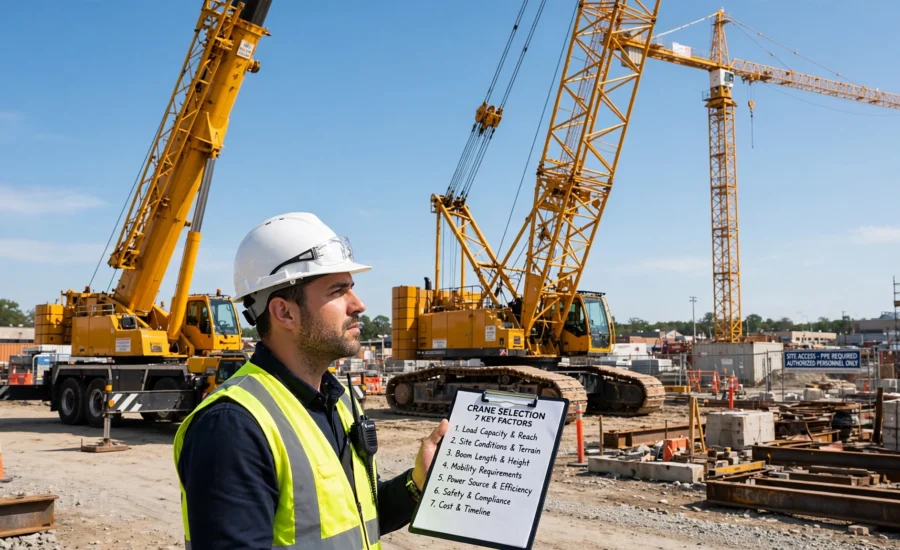
Crane selection is a critical business decision. Crane selection affects project success. Crane selection impacts safety outcomes. Crane selection determines operational costs. The choice influences project timelines. The right machine improves productivity. The wrong choice causes delays. The wrong choice creates safety risks. This guide covers crane selection thoroughly. This guide gives you 7 key factors. Crane selection requires careful analysis. The process demands accurate data. It needs professional judgment. Read this guide completely. Apply these factors to your projects.
Table of Contents
- 1. Why It Matters
- 2. Factor 1: Lifting Capacity Requirements
- 3. Factor 2: Reach and Height Requirements
- 4. Factor 3: Site Conditions
- 5. Factor 4: Mobility and Transport
- 6. Factor 5: Power Source and Fuel Efficiency
- 7. Factor 6: Safety Features
- 8. Factor 7: Cost and Budget
- 9. Selection by Project Type
- 10. Common Mistakes
- 11. Conclusion
- Our Business Partners
1 Why Crane Selection Matters
Crane selection is more than picking a machine. It involves matching equipment to needs. It requires understanding site conditions. It demands load calculations. It considers budget constraints. Proper evaluation reduces costs. Proper evaluation improves safety. Proper evaluation speeds up work. Poor decisions lead to accidents. Poor decisions cause equipment damage. Poor choices waste money. Poor choices delay projects. This is why crane selection deserves serious attention.
2 Factor 1: Lifting Capacity Requirements
The first factor is capacity. Capacity determines what you can lift. Capacity is the most basic criterion. List every item you plan to lift. Include the heaviest components. Include maintenance items. Include replacement parts. Add the rigging weight. Add the hook weight. Add the block weight. This total is your gross load.
Calculate Your Maximum Load
Identify your heaviest single lift. Check the weight from shipping documents. Verify with scale measurements. Add a safety margin of 20 percent. Never operate at maximum capacity. Select equipment with capacity above your needs. The machine must handle the load at the required radius. Capacity alone does not determine your choice. Radius and boom length also affect capacity.
Consider Future Needs and Capacity Ranges
Projects change over time. New equipment may be heavier. Production increases may require more lifts. Select equipment with extra capacity. Extra capacity handles future demands. Extra capacity provides flexibility. Extra capacity improves safety. Think long term for your equipment. Truck cranes range from 20 to 500 tons. Rough terrain units range from 20 to 100 tons. All terrain machines range from 50 to 1200 tons. Crawler units range from 50 to 3000 tons. Choose the type based on capacity needs. Capacity is the first step in crane selection.
3 Factor 2: Reach and Height Requirements
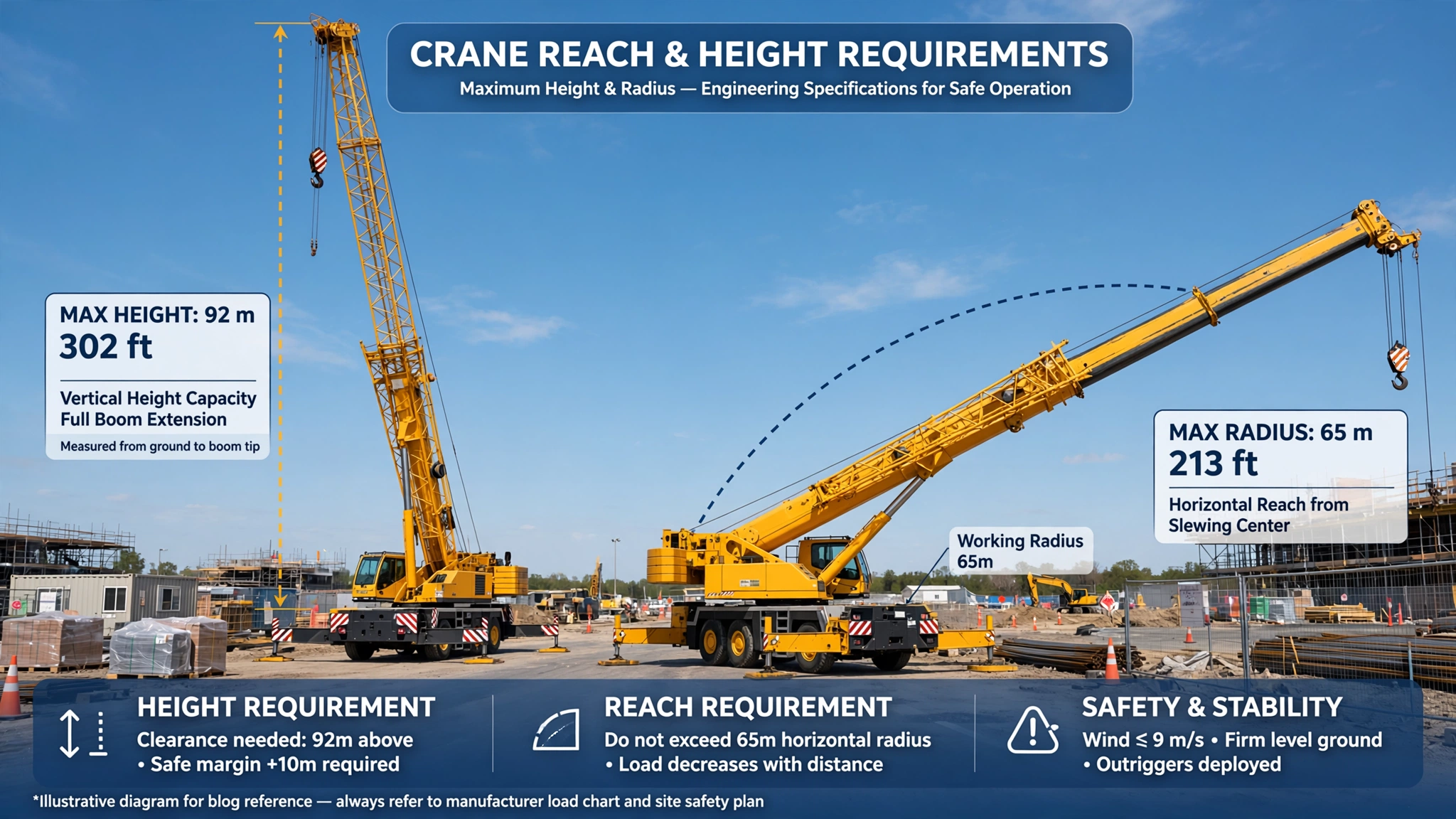
The second factor is reach. Reach includes height and horizontal distance. Reach determines boom requirements. Reach affects crane selection significantly. Measure your maximum lifting height. Measure your maximum horizontal distance. Consider obstacles in the load path.
Height and Horizontal Reach
Measure from the ground to the lift point. Include the hook height. Include the rigging height. Add safety clearance. Add boom deflection allowance. The boom must reach this height. Boom length matters for crane selection. Measure from the center to the load center. Consider obstacles between these points. Consider swing radius during rotation. The equipment must reach the load at this distance. Radius affects lifting capacity. Radius is critical for your decision.
Boom Options
Telescopic booms extend and retract quickly. Lattice booms offer greater reach. Telescopic booms suit urban projects. Lattice booms suit heavy lift projects. Choose the boom type carefully.
4 Factor 3: Site Conditions
The third factor is site conditions. Site conditions affect stability. Site conditions affect mobility. Site conditions affect setup. Evaluate your site thoroughly.
Ground Conditions and Accessibility
Is the ground paved or unpaved? Is the ground level or sloped? Is the ground wet or dry? Is the ground compacted or loose? Truck cranes need hard, level surfaces. Rough terrain units handle uneven ground. Crawler machines work on soft ground. Ground conditions guide your choice. How does the machine reach your site? Are roads wide enough? Are bridges strong enough? Are overhead power lines present? Truck cranes drive themselves. Crawler units need transport trailers. Accessibility affects your decision.
Working Space
Is the work area open or confined? Does the machine need swing clearance? Does it need outrigger space? Compact units work in tight spaces. Large machines need large working areas. Space availability affects crane selection.
When working in tight indoor or outdoor spaces where full crane operation isn’t feasible, specialized equipment like the TYPHON XFLEX-2031EM Electric Mini Scissor Lift provides safe elevated access.
5 Factor 4: Mobility and Transport
The fourth factor is mobility. Mobility affects how the unit moves. Mobility affects how it reaches sites. Mobility is key for multi-site projects.
On-Site Mobility and Road Travel
Does the machine need to move during the project? Does it need to reposition frequently? Wheeled units move faster. Tracked units move slowly. Mobility needs affect crane selection. Can it travel on public roads? Truck cranes drive on roads. All terrain units drive on roads. Rough terrain machines need transport. Crawler units need transport. Road travel capability affects your choice.
Transport Costs
Self-propelled units reduce transport costs. Trailer transport adds significant cost. Consider distance from the rental yard. Consider road permits. Consider escort vehicles. Transport costs affect crane selection.
Also, don’t miss learning about mobility features on road-friendly options in the truck crane 7 powerful features guide.
6 Factor 5: Power Source and Fuel Efficiency
The fifth factor is power. Power runs every function. Power affects operating costs. Power affects environmental compliance.
Engine Type and Fuel Consumption
Diesel engines are common. Diesel provides high torque. Diesel is fuel efficient. Electric units are available. Electric units are quieter. Electric units have zero emissions. Engine type affects crane selection. Mining operations run long hours. Construction sites run daily. Fuel costs add up quickly. Check the fuel consumption rate. Compare different models. Fuel efficiency saves money. Efficiency matters for your decision.
Emissions Compliance
Many sites have emission regulations. Underground sites have strict rules. Check for Tier 4 engines. Check for Stage V engines. Compliance avoids fines. Compliance protects workers. Emissions affect crane selection.
7 Factor 6: Safety Features
The sixth factor is safety. Safety protects operators and workers. Safety protects equipment. Safety is non-negotiable.
LMI and Anti-Two Block Systems
LMI monitors load conditions. LMI displays load weight. LMI shows capacity percentage. LMI alarms at overload. LMI prevents tipping. LMI is essential. Anti-two block prevents block jamming. The system stops hoist movement. The system prevents cable breakage. Every modern unit needs this system.
Visibility and Emergency Systems
Good visibility reduces accidents. Large windows help visibility. Camera systems help visibility. Mirror systems help visibility. Visibility affects crane selection. Emergency stops shut down the unit. Emergency stops work instantly. Multiple stops around the unit. Emergency systems are critical. Safety features guide crane selection.
8 Factor 7: Cost and Budget
The seventh factor is cost. Cost affects every decision. Cost includes purchase or rental price. Cost includes operating expenses. Cost includes maintenance.
Purchase vs. Rental and Operating Costs
Buying is a capital investment. Renting is an operating expense. Purchase saves long-term costs. Rental saves short-term costs. Consider your project duration. Consider your frequency of use. Cost model affects your decision. Fuel costs are predictable. Maintenance costs are scheduled. Insurance costs are standard. Operator costs are known. Total costs must fit your budget. Operating costs affect crane selection.
Return on Investment
The right unit pays for itself. The wrong unit costs money. Calculate the return on investment. Consider productivity gains. Consider safety improvements. ROI guides your choice.
9 Selection by Project Type
Different projects need different machines. This section helps with choosing for specific applications.
Construction, Industrial, and Mining
Building construction needs versatile units. Bridges need high-capacity machines. Industrial sites need specialized lifters. Rough terrain machines work in confined spaces. Mines need heavy-duty units. Crawler units handle extreme loads. They work on soft ground. Mining uses specialized choices.
10 Common Mistakes in Selection
Avoid these mistakes for better outcomes.
Underestimating Load and Ignoring Site Conditions
Load weights often exceed estimates. Add rigging weight. Add safety margin. Use certified measurements. Underestimation causes overload. Overload causes failure. Poor ground causes tipping. Test ground bearing capacity. Use appropriate mats. Level the unit properly. Site conditions matter for your decision.
Choosing by Price Only and Rushing the Process
Lowest price often means higher risk. Equipment may be older. Equipment may be poorly maintained. Operators may be less experienced. Choose value over price. Hasty decisions lead to errors. Take time to evaluate. Consult multiple sources. Verify all information. Good choices take time.
11 Conclusion
Crane selection is a vital process. The choice affects your entire project. It requires careful analysis. Use these 7 key factors. Evaluate lifting capacity requirements. Assess reach and height needs. Consider site conditions thoroughly. Determine mobility and transport needs. Check power source and efficiency. Verify all safety features. Calculate costs and budget.
The right machine improves productivity. The right machine enhances safety. The right machine reduces costs. The right machine completes your project on time. Use this guide on every project. Train your team on these principles. Review this guide regularly. Your project success depends on proper crane selection.
Start your process today. Collect the data you need. Consult with equipment suppliers. Get professional recommendations. Make an informed decision. Your projects will benefit from better crane selection.
12 Our Business Partners
We believe in collaborating with the best in the industry to bring unmatched value to our construction projects. Watch the video below to learn more about our operational standards and partnerships.


[…] as stable ground is necessary, understanding equipment limitations is vital. Read more about crane selection 7 key factors to ensure you’re using the right […]