
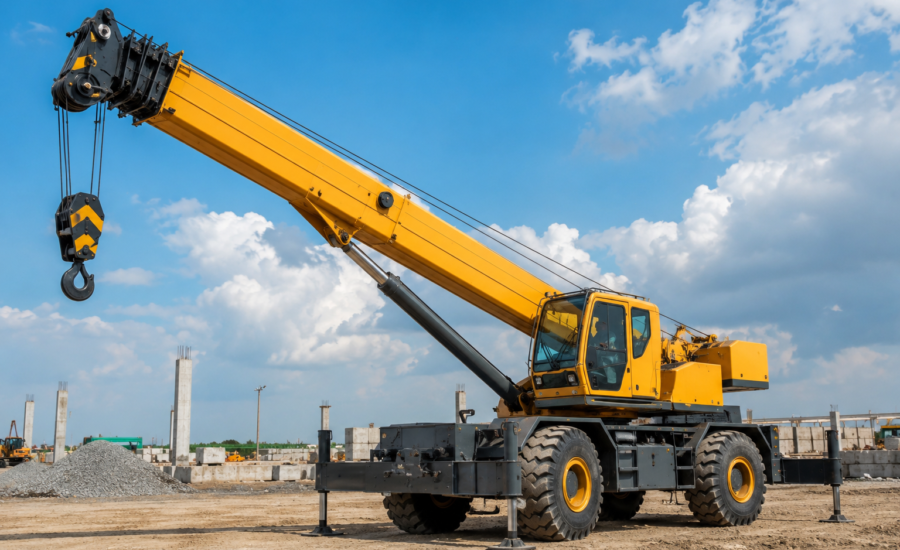
Understanding a rough terrain crane starts with the basics. It is a mobile lifting machine that has large rubber tires and a single cab design. The cab rotates with the boom, allowing the machine to work on uneven ground. This guide explains every feature, covers all benefits, and compares different models. It discusses applications and helps you select the right machine. This guide serves as an excellent resource for beginners and a reliable reference for project managers. Read this rough terrain crane guide completely and apply this knowledge on your next project alongside knowing how to properly read mobile crane load charts.
Table of Contents
- 1. What Is It?
- 2. Feature 1: Superior Off-Road Mobility
- 3. Feature 2: Single Cab Design
- 4. Feature 3: Telescopic Boom
- 5. Feature 4: Outrigger System
- 6. Feature 5: High Ground Clearance
- 7. Feature 6: Compact Size
- 8. Feature 7: Single Engine Design
- 9. Benefits of Using One
- 10. Common Applications
- 11. Conclusion
- Our Business Partners
1 What Is a Rough Terrain Crane?
This rough terrain crane guide defines the machine clearly. A rough terrain crane is a mobile lifter with four large rubber tires designed for off-road use. The tires provide traction on soft ground and stability on uneven surfaces. The cab sits on the upper structure and rotates with the boom, ensuring the operator faces the load at all times. The boom extends and retracts hydraulically to lift heavy loads and move around job sites.
Key Design Elements
A rough terrain crane has a compact design with a short wheelbase for tight turning. High ground clearance clears obstacles, while large flotation tires reduce ground pressure. It operates with a single engine that powers both travel and lifting. The engine sits in the carrier (the lower structure), while the upper structure contains the cab and the telescopic boom. These design elements support the ultimate rough terrain crane performance.
2 Feature 1: Superior Off-Road Mobility
Off-road mobility is the primary feature. The large tires have deep treads that grip loose soil, mud, gravel, and sand. A rough terrain crane climbs slopes and crosses challenging areas effortlessly. It does not need paved roads, allowing it to reach remote locations other lifters cannot.
Tire Design and Four-Wheel Drive
The tires are large, wide, and have low pressure to increase flotation and absorb ground irregularities. This provides a smooth ride and reduces operator fatigue. Additionally, the four-wheel drive system powers all wheels to prevent wheel spin in mud, sand, or wet grass. The operator can disengage it for road travel. Four-wheel drive is essential off-road.
Four-Wheel Steering
All four wheels turn, providing a tight turning radius. The machine maneuvers around obstacles easily. Operators can select front-wheel steering for road travel, four-wheel steering for job sites, or crab steering to position the machine precisely sideways. This flexibility is a core feature of a rough terrain crane.
3 Feature 2: Single Cab Design
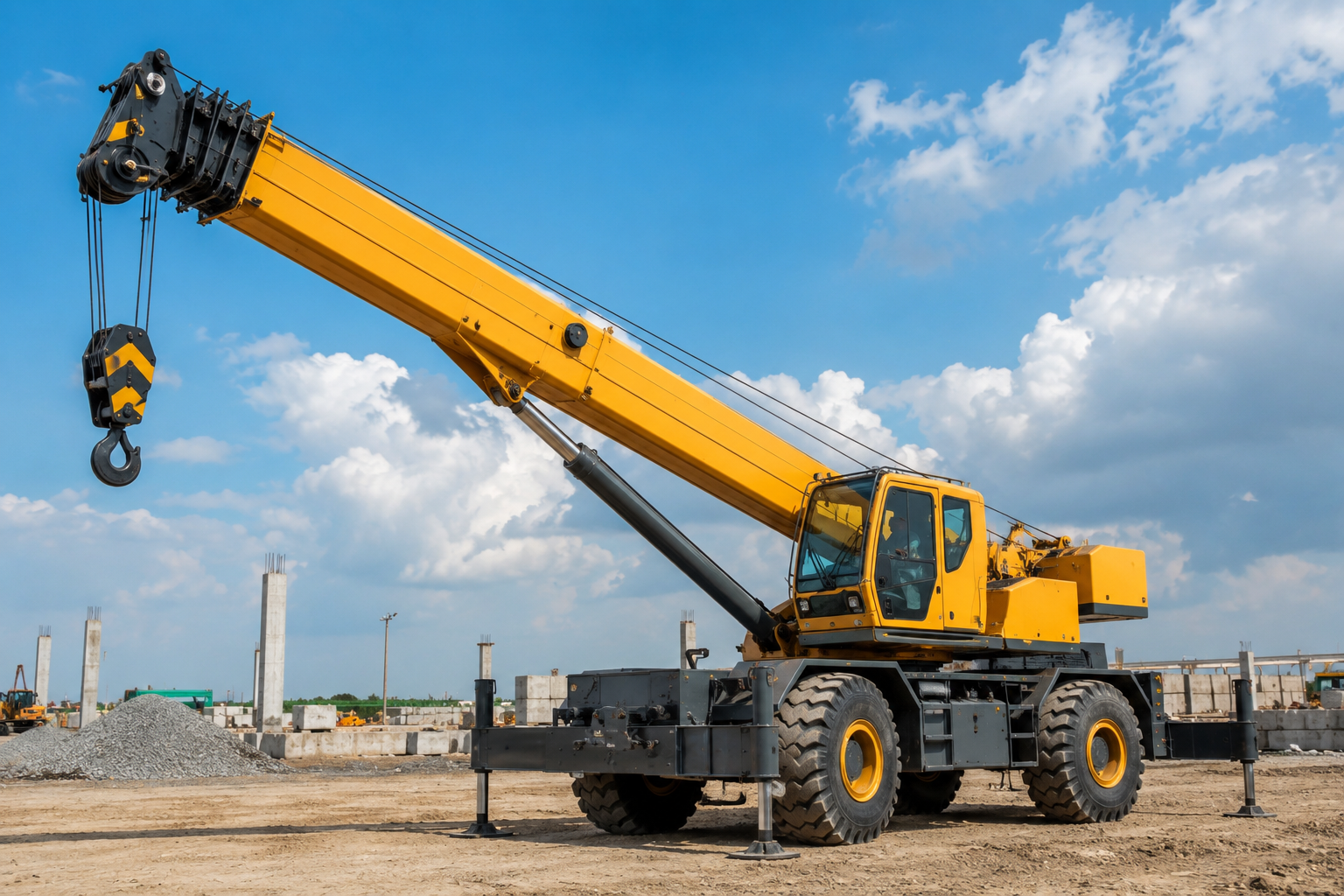
The single cab is unique for a rough terrain crane because it sits on the upper structure and rotates with the boom. The operator always faces the load and never works backward. This improves safety by providing full visibility of the load path, the landing zone, and ground conditions.
Operator Visibility and Comfort
Large windows position sightlines perfectly. The operator sees the boom tip, hook, load, and obstacles below. Mirrors and cameras help with blind spots. For comfort, the seat adjusts, controls are easily reachable, and the cabin features heating, cooling, and vibration isolation to reduce fatigue. Comfort supports safe rough terrain crane operation.
4 Feature 3: Telescopic Boom
A rough terrain crane boom extends and retracts using hydraulic cylinders that push sections smoothly. The operator controls the speed and length to extend for reach or retract for travel. Safety valves prevent sudden drops or uncontrolled movement.
Boom Length Capacity
Boom length affects lifting capacity. Longer extensions reduce capacity, while shorter ones increase it. The operator checks the load chart to select the right length, balancing reach and weight. Telescopic booms can easily reach over 100 feet, which is a key capability of a rough terrain crane.
5 Feature 4: Outrigger System
Outriggers provide crucial stability for a rough terrain crane. They extend from the carrier to contact the ground, leveling the machine and preventing tipping. The hydraulic system allows the operator to set them quickly.
Placement and Leveling
Full extension provides maximum stability, while partial extension offers reduced capacity. Operators place pads under them to distribute pressure and prevent sinking. Utilizing bubble or electronic levels, the machine must be perfectly leveled to prevent side tipping and ensure safe lifting.
6 Feature 5: High Ground Clearance
Ground clearance is the height under the machine. A rough terrain crane has high clearance to navigate over rocks, stumps, and debris without getting stuck or damaged.
Undercarriage Protection & Angles
Thick steel plates shield vital components like the drivetrain, hydraulic lines, and fuel tank from punctures. Additionally, steep approach and departure angles allow the machine to traverse ditches, mounds, and slopes without scraping.
If you are clearing heavy debris before positioning, earthmoving equipment like the TYPHON THUNDER VI 23HP Wheel Loader works excellently in tandem with these lifters.
7 Feature 6: Compact Size
A rough terrain crane is relatively small, fitting into tight spaces, urban areas, and confined sites perfectly. This practical size makes them highly versatile.
Transport Convenience and Maneuverability
The compact size simplifies transport. It fits on standard trailers without special permits or escort vehicles. This lowers transport costs and time. Once on-site, it turns in small circles, fits through narrow passages, and avoids obstacles efficiently, highlighting the agility of a rough terrain crane.
8 Feature 7: Single Engine Design
These machines have one engine in the carrier that powers travel, lifting, and all systems. This setup simplifies operation and maintenance.
Maintenance Efficiency and Weight Reduction
Technicians service one power source, check one fluid system, and diagnose fewer parts, significantly reducing downtime and service costs. Having only one engine also reduces total weight, meaning better flotation, higher payload, and improved fuel economy for the rough terrain crane.
9 Benefits of Using a Rough Terrain Crane
These features deliver real-world advantages. It works on unprepared, soft, or sloped ground and in confined remote locations. This site versatility saves substantial time and money.
Quick Setup and Cost Effectiveness
The operator extends outriggers, levels the machine, and extends the boom to be ready in minutes. Furthermore, reasonable rental rates, low transport costs, moderate fuel consumption, and high durability make the rough terrain crane highly cost-effective.
10 Common Applications
These machines serve many industries. On construction sites, they lift steel beams, place concrete panels, set HVAC units, and position formwork on muddy or compacted fill.
Infrastructure and Industrial Facilities
Infrastructure projects use them to set bridge girders, place culverts, install pipes, and work along highways. Inside industrial facilities, a rough terrain crane installs machinery, changes heavy parts, and unloads materials even in tight warehouse spaces.
11 Conclusion
You have learned the definition, the seven key features, benefits, and common applications. This machinery is versatile, reliable, safe, and cost-effective. It helps your project succeed by working where other equipment cannot.
It sets up quickly, maneuvers easily, provides excellent visibility, and keeps your team safe while reducing costs. Use this guide on your next project, share it with your team, and remember that choosing a rough terrain crane is often the right choice for challenging environments.
12 Our Business Partners
We believe in collaborating with the best in the industry to bring unmatched value to our construction projects. Watch the video below to learn more about our operational standards and partnerships.


[…] sure to review the core functionalities like those in the 7 key features and benefits […]