
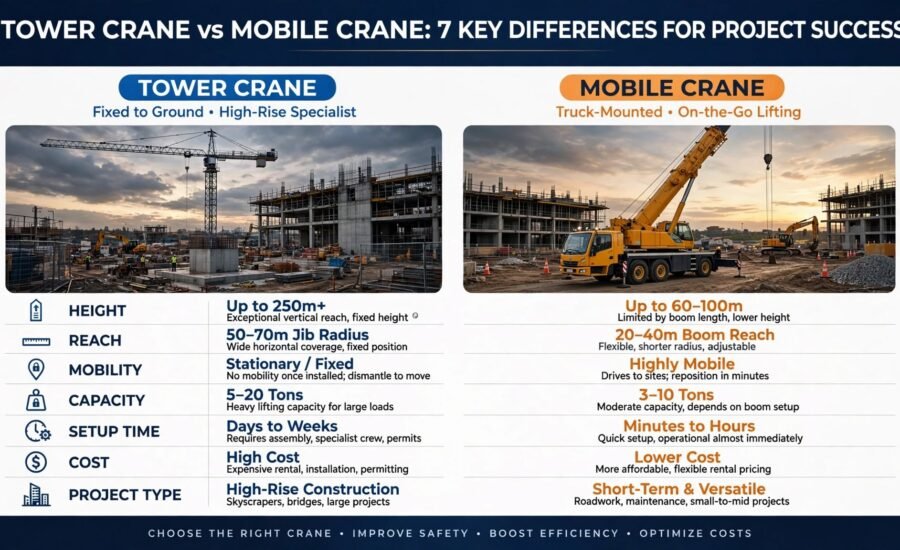
Tower Crane vs Mobile Crane is a decision every contractor faces. Evaluating Tower Crane vs Mobile Crane properly helps you avoid mistakes. Getting this choice wrong costs money. Getting it wrong costs time. Getting it wrong costs safety. The right crane moves a project forward. The wrong crane holds everything back. This guide covers Tower Crane vs Mobile Crane across seven areas. Read it before you commit to a crane, because a Tower Crane vs Mobile Crane comparison is vital.
Table of Contents
1 Start With the Basics
Tower Crane vs Mobile Crane begins with understanding each machine. A tower crane does not move. It stands on a concrete base. Its jib stretches sideways across the site. Materials travel along that jib. The crane reaches the top of tall buildings with ease. A mobile crane works differently. It rolls into the site on wheels. It extends legs for balance. Its boom angles upward. It works near the ground and at moderate heights.
What a Tower Crane Does
A tower crane owns one spot. That spot stays fixed for months. The crane serves the whole project from there. Steel beams go up. Concrete buckets travel to upper floors. Reaching high floors takes no extra effort.
What a Mobile Crane Does
A mobile crane goes where the work is. It handles several jobs in a day. It lifts heavy components when needed. It moves to the next site when finished. It needs no permanent base.
2 1. Assembly and Setup in Tower Crane vs Mobile Crane
The first Tower Crane vs Mobile Crane difference is setup time. A tower crane takes days. A mobile crane takes minutes.
Assembling a Tower Crane
A tower crane needs a foundation poured first. Concrete cures for weeks before work starts. A mobile crane helps lift the mast sections into place. Bolts join each mast section. The jib attaches at the top. Counterweights hang at the rear. The process runs several days. Certified riggers do the work. An inspector signs off before operation.
For minor groundwork or trenching around either crane setup, a compact machine like the TYPHON Terror XI 1.1 Ton Mini Excavator works perfectly.
Setting Up a Mobile Crane
The driver parks the crane. Legs extend outward. A level confirms the stance. The boom rises and extends. A short time later, the crane lifts. No foundation exists to pour. No assembly team stands by. Setup finishes within the hour.
3 2. Height and Reach
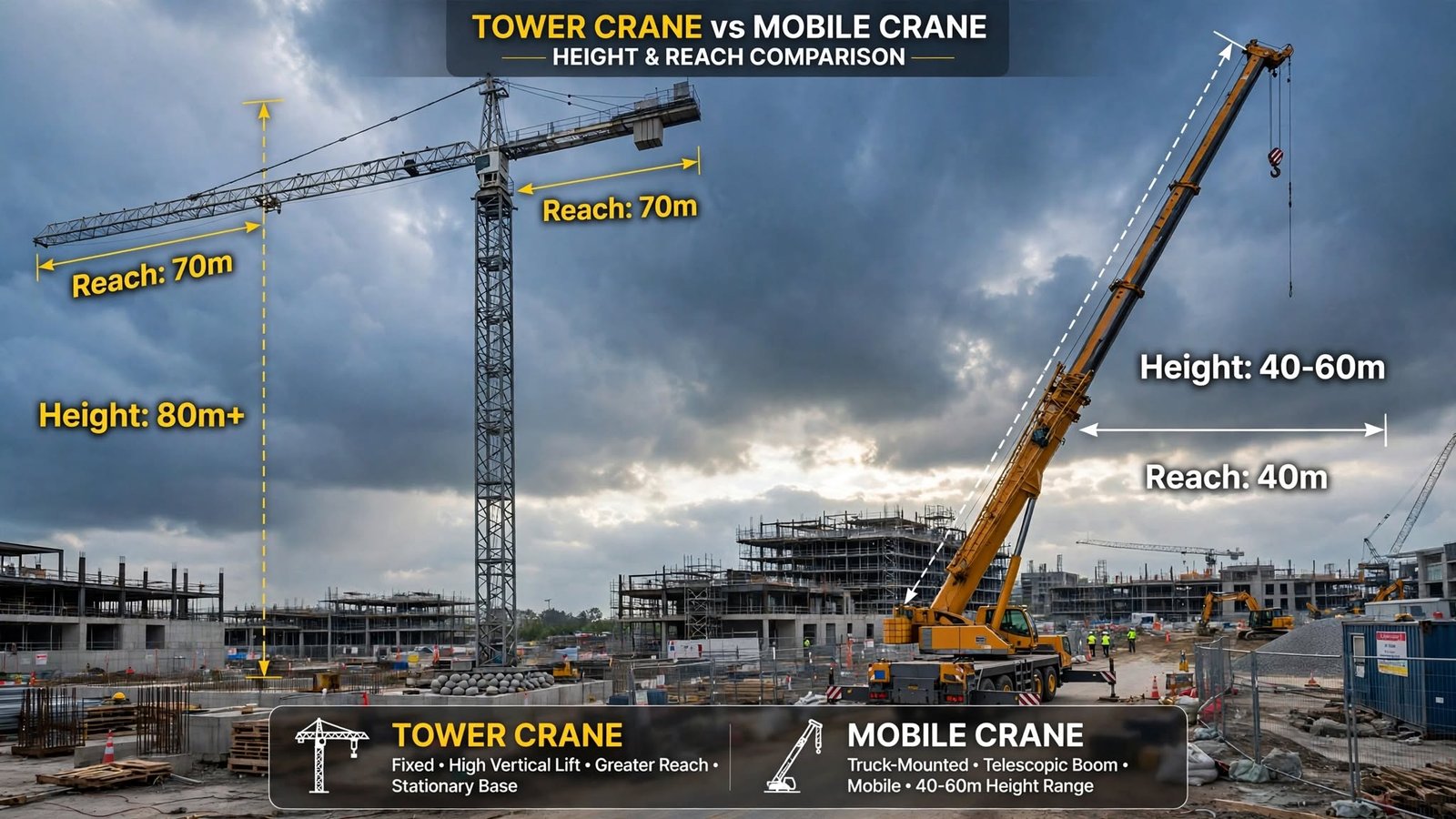
The second Tower Crane vs Mobile Crane difference is reach. One crane rules the skyline. The other rules the ground.
How High a Tower Crane Reaches
A tower crane jib spans a wide distance. Its height passes 800 feet on major projects. Loads travel anywhere along the jib. The full building footprint falls inside its reach. Top floors receive materials directly. The crane never shifts position for a new area.
How High a Mobile Crane Reaches
A mobile crane boom tops out between 100 and 300 feet. Each lift has a fixed radius. Repositioning happens for every new area. Capacity drops as radius grows. Tall buildings strain its limits. Low-rise work fits it perfectly.
4 3. Mobility
The third Tower Crane vs Mobile Crane difference is movement. One stays planted. One travels.
A Tower Crane Stays Put
A tower crane holds one position for the whole job. Moving it takes days. A new foundation waits at the new spot. Disassembly comes first. Reassembly follows.
A Mobile Crane Travels
A mobile crane drives between sites. It repositions in minutes. It serves several tasks in a single day. It relocates without tearing itself apart. It drives on public roads legally. This difference alone settles many project debates.
5 4. Cost
The fourth Tower Crane vs Mobile Crane difference is money. One front-loads its expense. One charges by the hour.
The Tower Crane Budget
A tower crane carries heavy upfront costs. The foundation alone eats a large chunk of budget. Assembly and disassembly add more. Monthly rental sits high. Operators command premium wages. Long projects absorb these costs well. Short projects drown in them.
The Mobile Crane Budget and Break-Even Point
A mobile crane bills by the hour. Daily, weekly, and monthly rates exist. No foundation exists to pour. No assembly crew stands waiting. Short projects fit this model well. Long projects let hourly costs pile up.
Projects past six months favor a tower crane. Shorter projects favor a mobile crane. Total lift hours decide the math. Count every lift before choosing. Real numbers beat rough guesses.
6 5. Lifting Capacity
The fifth Tower Crane vs Mobile Crane difference is lifting power. The two cranes handle different load profiles.
Tower Crane and Mobile Crane Lifting Power
Typical tower cranes lift moderate loads. Capacity drops as the jib extends outward. Loads travel the full jib length. Concrete buckets move efficiently. Steel beams reach high floors. Repetitive lifts suit this crane well.
Mobile cranes lift far heavier loads. Capacity drops as radius grows. Heavy equipment moves easily. One-time heavy lifts fit its strengths. Industrial projects rely on it.
Matching the Load
Check the heaviest load first. Check the farthest radius next. Read the load chart for both numbers. Confirm capacity at the working radius before the lift begins.
Contractors using multiple machines should also explore the 7 best-selling TYPHON skid steer models to support their primary lifting operations.
7 6. Site Impact
The sixth Tower Crane vs Mobile Crane difference is site footprint. The two cranes leave different marks on a site.
Tower Crane Footprint vs Mobile Crane Footprint
A tower crane owns a permanent base. That base takes ground space. The jib swings over the entire site. Other equipment routes around it. Swing paths must stay clear. The crane remains through the whole project.
A mobile crane needs temporary space. It positions for each lift. It clears out afterward. Other trades share the area. The ground holds the load only while lifting happens. Once the crane leaves, the site returns to normal.
8 7. Safety
The seventh Tower Crane vs Mobile Crane difference is safety. Both demand trained crews. Both demand daily checks.
Tower Crane and Mobile Crane Safety
A tower crane works high above the crew. Loads travel overhead. Wind speed matters at that height. Aviation lights warn aircraft. Structure checks happen regularly. Foundation monitoring never stops.
A mobile crane works near ground crews. Ground stability matters most. Outrigger checks happen daily. Swing radius control protects workers. Load paths need planning. Wind speed matters at boom height.
Shared Safety Ground
Certified operators run both cranes. Qualified signal persons guide both. Daily inspections apply to both. Load charts govern both. Lift plans cover both. Emergency procedures exist for both.
9 Choosing Between Them: Tower Crane vs Mobile Crane
Tower Crane vs Mobile Crane choices follow project needs. Use these guidelines for a clear decision.
Pick a Tower Crane When
The project runs six months or longer. The building passes ten floors. Ground space is tight. Materials flow constantly. One fixed lift point works best.
Pick a Mobile Crane When
The project lasts weeks or months. The building stays under ten floors. Flexible lifting matters. Heavy one-time lifts dominate. Work moves between locations.
10 Using Both Together: Tower Crane vs Mobile Crane
Tower Crane vs Mobile Crane is not always a strict either-or. Many projects use both machines. A mobile crane assembles the tower crane. A mobile crane handles foundation work. A tower crane moves daily materials. A mobile crane lifts final heavy equipment. Mixed fleets often win.
11 Conclusion
Tower Crane vs Mobile Crane rewards careful study. Every Tower Crane vs Mobile Crane debate requires objective analysis. Assembly and setup differ greatly. Height and reach split sharply. Mobility works in opposite ways. Cost structures follow different shapes. Lifting capacity serves different loads. Site impact looks nothing alike. Safety profiles differ by position.
Tower Crane vs Mobile Crane has no single answer. When making a Tower Crane vs Mobile Crane decision, don’t rush. Project duration decides the cost case. Building height decides the reach case. Site space decides the footprint case. Lift frequency decides the workflow case. Decisions need real data. They need expert input. They need honest comparison.
Apply this guide to your next project. Compare costs with real numbers. Compare capabilities with real loads. Compare sites with real measurements. Your Tower Crane vs Mobile Crane evaluation will define your workflow. Tower Crane vs Mobile Crane choice shapes project success.
12 Our Business Partners
We believe in collaborating with the best in the industry to bring unmatched value to our construction projects. Watch the video below to learn more about our operational standards and partnerships.


[…] from a major brand costs $30,000 to $50,000. The TERROR XVIII sells for around $11,000. That is a massive difference in capital. For a small business, this is the difference between starting a company and staying an […]